In 2026, the UAE construction industry continues to grow, but it also faces intense competition, rising costs, and new regulatory requirements. The VAT system (5%) has been in place since 2018, mandatory e-invoicing is scheduled for 2027, and the WPS system controls salary payments. In such conditions, automating business processes with ERP is no longer optional—it is essential.
While exact ERP implementation costs for a construction company in the UAE vary based on specific requirements, the total market budget typically ranges from AED 40,000 for basic setups to over AED 300,000+ for enterprise-grade, multi-entity construction ERPs.
In this article, we will explore what ERP for construction entails, the factors influencing its cost, expected budgets for companies of different sizes, and provide practical recommendations (with insights from First Bit) for selecting and evaluating an implementation project.
Summary
-
Average market range: AED 40,000 (basic) to AED 300,000+ (enterprise).
-
Implementation cost: Typically 30–50% of the total software licensing cost.
-
Target audience: Comprehensive construction ERPs are most cost-effective for companies with 100+ employees managing multiple sites.
-
Critical UAE factors: Built-in VAT, WPS compliance, and Arabic support are mandatory and impact pricing.
What Is ERP for Construction and Why Standard Solutions Don’t Work in the UAE
ERP (Enterprise Resource Planning) is a suite of business applications that integrates all key company processes—from accounting and inventory management to project management and procurement.
In the construction industry, ERP focuses on project cost accounting: uploading BOQs, allocating expenses across materials, labor, and overheads, and monitoring budgets and profitability for each project. Contractors also require specialized features such as tracking material movements on-site, managing subcontractors, controlling equipment, and integrating with BIM models.
Standard off-the-shelf ERP systems often fail to address local requirements. To comply with UAE regulations, an ERP must support:
-
Automatic VAT reporting in line with FTA standards
-
Payroll calculation with WPS file generation
-
Multi-currency operations
-
Arabic-language interface
Otherwise, significant customization will be required, increasing both cost and implementation time.
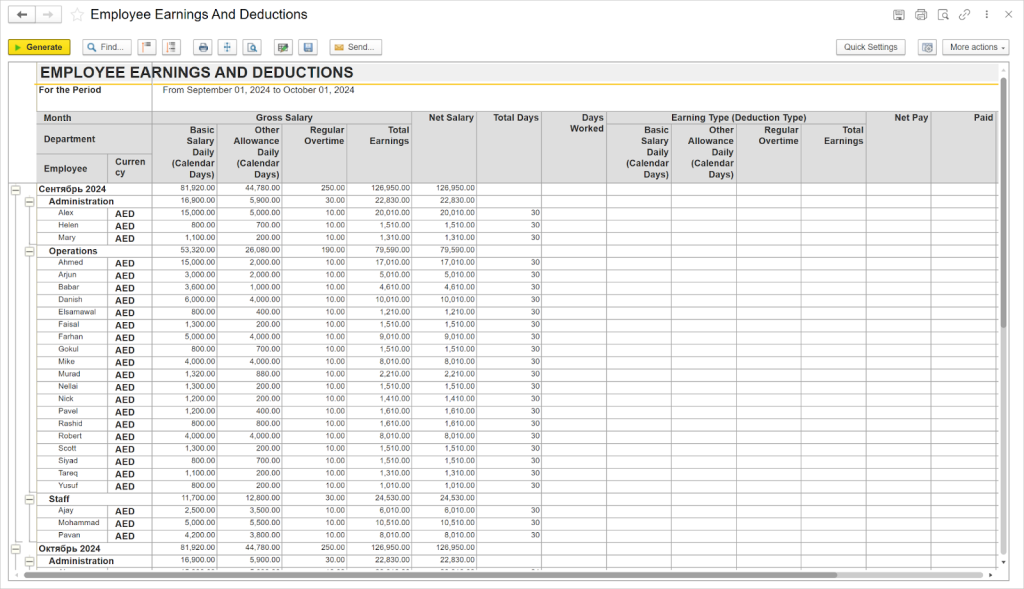
Payroll run: earnings, overtime, deductions, and net salary in FirstBit ERP Contracting
FirstBit ERP Contracting is
construction cost management software that helps you optimize budgets, control project costs, and monitor each project from both financial and operational perspectives. Adapted to the UAE construction market, it reduces manual work with BOQ uploads, cost allocation, VAT reporting, and WPS file generation.
That’s why choosing a system tailored to local realities is critical: generic ERP solutions for trading or manufacturing may require costly localization and still fail to meet construction-specific needs.
Free up your time with FirstBit ERP
Automate routine work and focus on growth
Request a demo
Key Factors Affecting ERP Implementation Cost in Dubai in 2026
ERP pricing depends on multiple variables. The main drivers of construction erp system cost in the UAE include:
1. Localization
Adapting the system to UAE legislation is essential. This includes VAT reporting, WPS compliance, cost estimation standards, and Arabic interface support. These requirements significantly impact cost.
For example, solutions like FirstBit ERP can support VAT workflows, WPS processes, project cost estimation, and in two languages (English and Arabic) within a single system. This reduces manual work and helps contractors stay compliant.
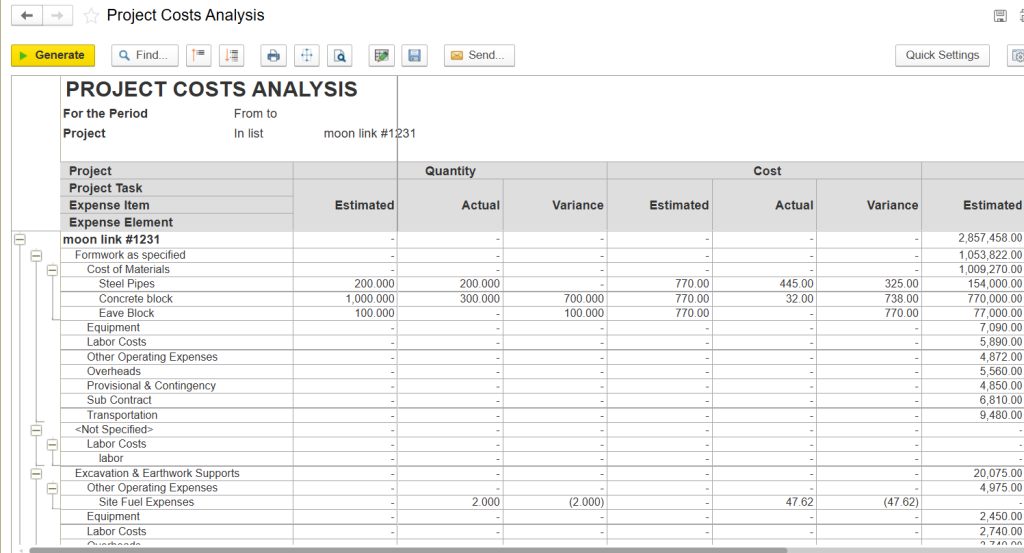
Project cost breakdown in FirstBit ERP
2. Company Size
Larger companies require more users, licenses, and data handling capacity. Construction holdings often include multiple legal entities and offices, requiring complex accounting and intercompany integrations.
For example, FirstBit ERP for contracting supports multi-company operations, including separate legal entities, branches, and intercompany transactions. It can also be customized to match the structure and processes of a growing business. This helps maintain control across the group while keeping records at the entity level.
3. Platform and Licensing Model
-
Cloud solutions: Lower upfront cost (subscription-based), typically shifting ERP spending toward an OpEx (Operating Expenditure) model with predictable recurring payments, but can become more expensive over time.
-
On-premise solutions: One-time license fee plus ongoing maintenance costs, typically requiring higher upfront CapEx (Capital Expenditure) for software, infrastructure, and deployment.
Some ERP solutions, including FirstBit ERP Contracting, are available in both cloud-based and on-premise versions, depending on a company’s operational needs, IT setup, and internal maintenance preferences. This also gives businesses greater flexibility when evaluating CapEx vs OpEx and planning ERP implementation, infrastructure investment, and long-term system costs.
4. Integrations and Customization
ERP systems often need to integrate with:
-
Banks (for WPS)
-
FTA portal (for e-invoicing)
-
Municipality systems
-
CRM, e-commerce, BIM tools
Each integration increases the budget. In the UAE, this may also include solutions like FirstBit ERP, which addresses some of the most common needs, including FTA-related VAT compliance workflows, WPS file generation for salary transfers, and a built-in CRM module.
5. Modules
The more modules included, the higher the cost. Basic packages include accounting, inventory, and project tracking, while advanced ones include BOQ management, procurement, and analytics.
In practice, systems like FirstBit ERP Contracting can also be expanded with modules such as HR and payroll, warehouse management, equipment management, finance and accounting, procurement, project management, and project cost control, depending on the company’s needs.
6. Implementation and Training
Implementation (setup, data migration, training) typically accounts for 30–50% of total project cost. Proper training significantly improves ROI. This is also where vendor support becomes important. In the case of FirstBit ERP, the team provides training during implementation, helps users work through daily transactions after go-live, and continues to support the system through regular updates and a dedicated support team.
What Is the Average ERP Budget for UAE Construction Firms
In 2026, ERP implementation budgets for UAE construction companies typically range from around AED 40,000–150,000 for growing contractors to AED 150,000–400,000+ for mid-market and enterprise construction firms with 100+ employees.
For larger contractors, the first-year budget can exceed AED 500,000 when the project involves multiple legal entities, advanced BI, BIM integrations, extensive customization, or complex third-party integrations.
Everything you need for success in one powerful ERP solution
Request a demo
Market Pricing Ranges by Company Size
Note: The figures below represent average market ranges for ERP implementation in the UAE construction sector in 2026, not specific FirstBit ERP pricing. Final costs depend on a custom technical assessment.
Growing Contractors (50–100 employees)
Functionality:
Budget:
-
Typically AED 40,000–100,000
-
Can reach AED 120,000–150,000 with additional modules, customization, and integrations
Mid-Market to Enterprise Construction Firms (100+ employees)
For construction companies with 100+ employees, the focus shifts from basic compliance to complex multi-entity consolidation, advanced BI, and deep BIM integrations. Market budgets for this segment typically range from AED 150,000 to AED 400,000+ for the first year, depending on customization.
Functionality:
-
BOQ and project cost management
-
Advanced budget control and cost forecasting
-
Procurement automation and approval workflows
-
Subcontractor management
-
Asset and equipment management
-
Mobile access for site and project teams
-
Consolidated financial reporting
-
BIM and third-party system integrations
-
Advanced BI dashboards and management reporting
-
Multi-currency and multi-entity accounting
Budget:
-
Typically AED 150,000–400,000+ for a comprehensive ERP implementation
-
Can exceed AED 500,000 for highly customized, multi-entity solutions with advanced integrations, BIM, BI, and complex enterprise workflows
Solutions like FirstBit ERP can support both smaller contractors and larger construction groups, scaling as projects, teams, and operational needs grow. To choose the right configuration for your business, review the
ERP implementation cost and find an option that fits your company’s current needs and future plans.
Understanding Total Cost of Ownership (TCO) for Construction ERP
For UAE construction companies, the true cost of an ERP system goes beyond the initial software price. A more accurate way to evaluate the investment is through Total Cost of Ownership (TCO), which includes implementation, data migration, training, ongoing support, and future upgrades.
TCO (Total Cost of Ownership) Framework for UAE Construction
Year 1 cost = software licensing + implementation (30–50%) + data migration + training
The first-year budget typically includes the software itself, system configuration and implementation, migration of historical and operational data, and user training.
Years 2–3 cost = annual support (15–20%) + upgrades
Ongoing costs may include technical support, system upgrades, additional integrations, new users, and further customization as the company grows.
For mid-market and enterprise construction companies, evaluating ERP through a multi-year TCO model provides a more realistic basis for budgeting and vendor comparison than looking at licensing costs alone.
Connect your office and site teams
Synchronize workflows and approvals with FirstBit
Request a demo
Why "Cheap" ERP Systems Cost More in Construction
A low construction ERP price can be misleading for builders and contractors. Basic systems often lack construction-specific and UAE-compliance functionality, which can increase the total cost after implementation.
The most common risks of choosing a low-cost ERP include:
-
Missing WPS compliance can create regulatory risk. If payroll processes are not properly aligned with the UAE Wage Protection System, companies may face payment delays, compliance issues, and restrictions on new work permits.
-
No built-in WIP tracking means more manual work. Without Work in Progress (WIP) accounting, finance teams may need spreadsheets or custom reports to track project costs, revenue recognition, and profitability.
-
Limited CVR functionality reduces cost visibility. If the ERP does not support Cost Value Reconciliation (CVR), contractors may need additional customization to compare project costs, value earned, forecasts, and margins.
-
Customization and rework can erase the initial savings. Adding missing construction workflows, integrations, reporting, and compliance features later can make a low-cost ERP more expensive over its lifecycle than a system designed for construction from the outset.
Hidden Costs of ERP Implementation in the UAE
Common overlooked costs include:
-
Additional training and post-launch support
-
Data migration and cleanup
-
Business process changes
-
Additional modules and users
-
Regulatory updates (VAT, WPS changes)
These can add 10–20% to the total budget.
Gain full control of your business
Request a demo
How to Choose the Right ERP: Step-by-Step Guide
- Analyze current processes. Identify inefficiencies, delays, and workflow gaps across departments.
- Define requirements (VAT, WPS, BOQ, mobile access). Make sure the ERP covers both compliance requirements and daily operational needs.
- Request demos from vendors. Assess usability, reporting, and fit for your actual workflows.
- Check integrations (banks, FTA, CRM, BIM). Confirm which connections are available out of the box and which require additional customization.
- Evaluate vendor experience in UAE construction. Review similar projects, implementation approach, and understanding of local requirements.
- Request a detailed pricing breakdown. Analyze the costs associated with licensing, implementation, support, customization, and future scalability.
- Consider starting with a pilot phase. Test key workflows before the full rollout and reduce implementation risks.
When considering
ERP for construction business owners, it is important to evaluate not only the initial cost but also implementation, scalability, reporting, and long-term control over the business.
The same checklist can be used to evaluate solutions like FirstBit ERP Сontracting against your business requirements, technical setup, and implementation priorities.
Conclusion
Implementing ERP for a construction company in the UAE is a major investment—but one that pays off through improved transparency, automation, and cost control.
A properly localized system (VAT, WPS, e-invoicing) tailored to construction specifics can significantly increase efficiency and reduce risks.
To accurately estimate ERP costs and select the best solution, it is recommended to consult experts. First Bit, an international integrator with strong GCC experience, can provide a demo and prepare a customized implementation plan for your business.
Free up your time with FirstBit ERP
Automate routine work and focus on growth
Request a demo
FAQ
What is the average cost of ERP implementation for a mid-sized construction company in Dubai?
For a mid-sized construction company in Dubai, ERP implementation typically ranges from AED 40,000 to AED 150,000, and can reach AED 200,000–250,000 when significant integrations or customization are required. The final budget should be assessed through Total Cost of Ownership (TCO), which includes not only licensing and implementation, but also data migration, training, support, upgrades, and future system expansion.
Does FirstBit ERP publish a fixed price list for construction companies?
No. FirstBit ERP does not publish a fixed price list for construction companies because the final cost depends on factors such as the number of users, required modules, deployment model (cloud vs. on-premise), implementation scope, and customization requirements. First Bit provides customized quotes based on each company’s needs.
As a general market benchmark, construction ERP implementation for mid-sized companies can start at around AED 40,000, while more complex mid-market and enterprise projects can reach AED 150,000–400,000+.
What is the average monthly or yearly subscription cost for construction ERP software in the UAE?
Cloud-based construction ERP pricing in the UAE varies widely by functionality and company size. For advanced construction ERP solutions, a practical planning range is around AED 500–1,500 per user per month, depending on modules such as WIP tracking, WPS payroll, advanced BI, integrations, and support. However, published entry-level solutions can cost substantially less, while enterprise platforms are often priced individually based on implementation scope and user requirements.
What are the hidden costs of ERP implementation in the UAE construction industry that I should budget for?
Beyond the base software license, construction companies in the UAE should budget for:
1. Data migration and cleanup (10–15% of the budget)
2. Customization for UAE compliance (VAT, WPS, e-invoicing)
3. Post-launch support and annual maintenance (typically 15–20% of the license cost)
4. Change management and advanced user training.
How do I calculate the Total Cost of Ownership (TCO) for an ERP system over 3 to 5 years?
To calculate the 3-year TCO for a construction ERP, use this formula:
(Initial License/Subscription + Implementation Costs + Data Migration) + (Annual Support & Maintenance Fees × 3) + (Estimated Cost of Future Module Add-ons). Implementation typically accounts for 30–50% of the first-year cost.)












'%3e%3cg%20clip-path='url(%23clip1_6548_6055)'%3e%3cpath%20d='M13.974%2015.6195C14.2724%2016.0185%2014.6532%2016.3487%2015.0905%2016.5876C15.5278%2016.8265%2016.0114%2016.9686%2016.5084%2017.0042C17.0055%2017.0398%2017.5043%2016.9681%2017.9712%2016.7939C18.4381%2016.6198%2018.8621%2016.3472%2019.2143%2015.9948L21.2994%2013.9098C21.9324%2013.2544%2022.2827%2012.3766%2022.2747%2011.4654C22.2668%2010.5543%2021.9014%209.68269%2021.257%209.03839C20.6127%208.39408%2019.7412%208.02862%2018.83%208.0207C17.9189%208.01278%2017.0411%208.36305%2016.3857%208.99606L15.1902%2010.1845M16.754%2014.2295C16.4555%2013.8305%2016.0747%2013.5003%2015.6374%2013.2614C15.2002%2013.0225%2014.7166%2012.8804%2014.2196%2012.8448C13.7225%2012.8092%2013.2237%2012.8809%2012.7568%2013.0551C12.2899%2013.2292%2011.8659%2013.5018%2011.5136%2013.8542L9.42861%2015.9392C8.7956%2016.5946%208.44534%2017.4724%208.45326%2018.3836C8.46117%2019.2947%208.82664%2020.1663%209.47094%2020.8106C10.1152%2021.4549%2010.9868%2021.8204%2011.898%2021.8283C12.8091%2021.8362%2013.6869%2021.4859%2014.3423%2020.8529L15.5308%2019.6645'%20stroke='%235F7896'%20stroke-width='1.39002'%20stroke-linecap='round'%20stroke-linejoin='round'/%3e%3c/g%3e%3c/g%3e%3crect%20x='0.438953'%20y='0.438953'%20width='28.9709'%20height='28.9709'%20rx='14.4855'%20stroke='%235F7896'%20stroke-width='0.877907'/%3e%3cdefs%3e%3cclipPath%20id='clip0_6548_6055'%3e%3crect%20width='29.8488'%20height='29.8488'%20rx='14.9244'%20fill='white'/%3e%3c/clipPath%3e%3cclipPath%20id='clip1_6548_6055'%3e%3crect%20width='16.6802'%20height='16.6802'%20fill='white'%20transform='translate(7.02344%206.58435)'/%3e%3c/clipPath%3e%3c/defs%3e%3c/svg%3e)